In music education, the word “beginner” is often tied solely to elementary school use, as if starting a skill after sixth grade is somehow “too late”. But why? In nearly every other area of life–fitness, dance, the arts and other hobbies–we celebrate adult beginners and lifelong learning. As of late, many students have moved between districts, states, or even countries without access to continued instrumental music. Instead of reinforcing a narrative of missed opportunity, why not offer instrumental study as a bridge from “I wish I had” to “I’m learning now” to all grade levels?
Why It Started in Brooklyn, NY
The majority of elementary and middle schools in New York City do not offer instrumental music; most provide only general music if they offer a music program. When instrumental programs do exist, students often matriculate to specialized performing arts high schools across the five boroughs, regardless of proximity to their local schools. This creates commuting challenges for families and leaves neighborhood high schools competing for enrollment. Additionally, this leaves many high schools without a reliable feeder pipeline for instrumental music.
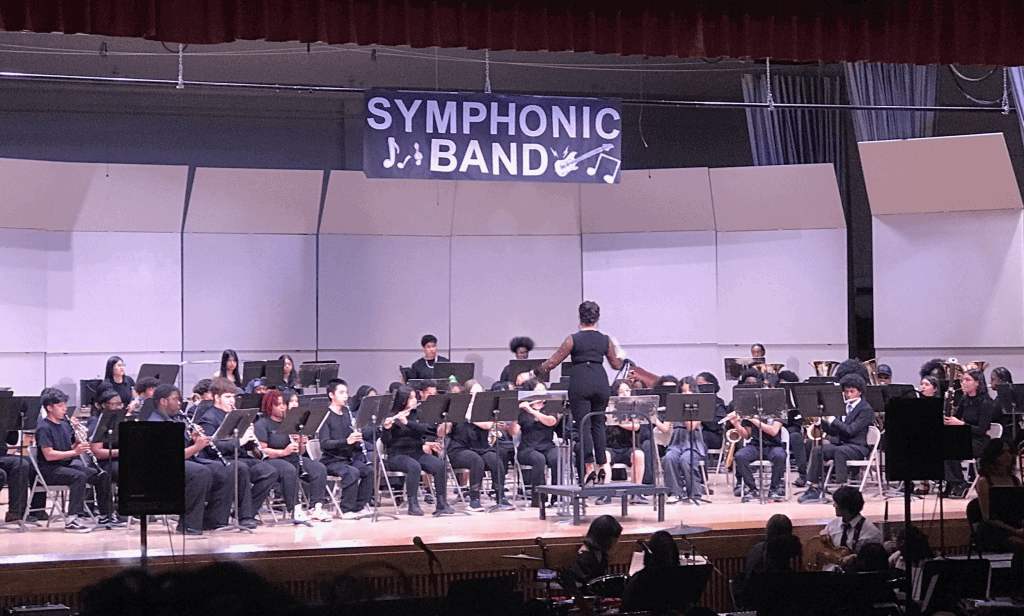
At Grand Street Campus High Schools in Williamsburg, Brooklyn, three high schools function as one community through the shared music and athletics departments. For over twenty years, we have offered a beginner band course as the general music course requirement for our students grades 9-12. From the one-year beginner band course, we have been able to produce various tiers for instrument ensembles for students of all levels; including, three upper traditional concert bands, three levels of jazz bands, two levels of modern band, and a marching band. All classes meet daily for credit.
What is Required and How to Begin
Start small with one class and grow intentionally. A single section can lay the foundation for an entire program to grow.
At minimum, you will need:
- A classroom set of instruments and method books
- Mouthpieces, reeds and basic supplies
After the initial investment in school-owned instruments, ongoing costs are often lower than many high school general music courses that rely on technology, textbooks or specialized equipment, and classroom instruments.
The first step is a conversation with your administrative team and principal. While budgets vary, funding solutions often exist when the vision is clear. If there are limited resources, do not be discouraged. Numerous grants and fundraising opportunities can support startup costs, including:
- DonorsChoose
- Guitar Center Music Foundation
- Save the Music Foundation
- Mr. Holland’s Opus Foundation
- Music Drives Us Instrument Grant
- Music Will
- Local television and radio stations (e.g. WQXR Grant in NYC area)
Once instruments and funding are secured, the real work begins!
Getting Started: The First Year
Introduce instruments in a way that fits your program and students. You might begin with mouthpiece testing, “experiments” to gauge comfort and potential success, or start with student interest alongside physical considerations. Expose students to each instrument’s sound through an instrument zoo, professional video and audio recordings, or live demonstrations by you and your colleagues.
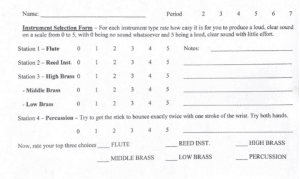 Once instruments are assigned, prioritize fundamentals: tone production, basic technique, music literacy, and instrument care. In the fall semester, focus on building strong sounds, then introduce rhythm and the first few notes according to your chosen pedagogy and method book.
Establish clear individual and ensemble goals early–mastering playing and rest position, starting and stopping together, and performing short lines from the method book or even a Grade 0.5 piece. Plan a winter concert if possible, or record a performance to share with families and administrators in your school community. Even if students perform only a few lines, treat it as a major event. For many, it is their first performance, and every milestone deserves a celebration!
Carry that momentum into the spring. Continue building skills through your method book and supplemental materials while preparing for a culminating performance–a spring concert or festival. In New York State, for example, our beginners prepare a Level 1 program for the New York State School Music Association (NYSSMA) Majors Evaluation. While not a competition, it provides valuable feedback on ensemble growth. When students start from scratch, recognition from experienced adjudicators is a powerful affirmation of their progress–and the momentum needed for program retention and growth.
The Why
As music educators, we understand the importance of music being active–a verb–rather than something observed from a distance. We want our students creating, performing and evaluating, truly “musicking”. So, why is a music appreciation course often the sole experience offered for our secondary level students? Watching music being made has value, but we would never ask students to watch math being done instead of solving problems themselves.
Teaching a beginner band can help fill in any instrumental gaps in your existing programs. Do you not have a double reed or tuba in your upper ensemble? Start them in Beginner Band!
More importantly, a beginner band in the secondary level creates an equitable nature in the classroom. The prior barrier of “it’s too late to start” disappears–everyone begins together. But those are not the only barriers students can find in their educational experiences. Many of our students at Grand Street Campus are entering high school with language barriers. In response to a large student population entering as Spanish-speakers within the past five years, we have begun teaching Beginner Band as a dual language setting. The result? Our students learn faster and with more confidence because someone is speaking to them and attempting to communicate with them at their level. One student, Tania a 2025 graduate and flautist, from Ecuador expressed:
“Being taught music in my language helped me learn better, not just music but English as well. I have noticed that it has helped me listen better in English, which has made it easier for me to learn. To me, that is very important to have that foundation in Spanish, in the native language to understand, for you can continue playing your instrument and improving. It is never too late to learn an instrument. I had no idea how to play one, and now I have the opportunity to play the flute. That felt like something unreachable, but I did it”
Conclusion
Beginning Band at a secondary level is not a compromise but an opportunity to expand access to more students, to rebuild any gaps in the feeder pipeline, and to fortify retention in your programs; most importantly, to change a student’s life. We do not exist to serve a set grade or level. Whether at the elementary or high school level, we have a responsibility to students of all ages, levels and backgrounds. It is never too late to begin, and when students feel safe and free to try something new, we build stronger communities inside the classroom and beyond. You never know which ceiling will be shattered next.
Karla Aristy DeJesus is a graduate of New York University (BM in Music Education) and CUNY Queens College (MM in Saxophone Performance). Currently, she is one of the band directors at the Grand Street Campus (GSC) High Schools, where she directs three out of the four upper-level ensembles (Symphonic Band, Repertory Band, and Jazz Band B), and enjoys teaching the Beginner Band students; in total, the music program houses about 400 students. One of the pleasures she has at GSC is the dual language teaching approach she has incorporated in the band classroom setting, as Karla is a fluent Spanish speaker. She also serves as a woodwind adjudicator for NYSSMA and has recently served as the Brooklyn North Band Teacher Team Leader for NYCPS.






Leave a Reply
You must be logged in to post a comment.