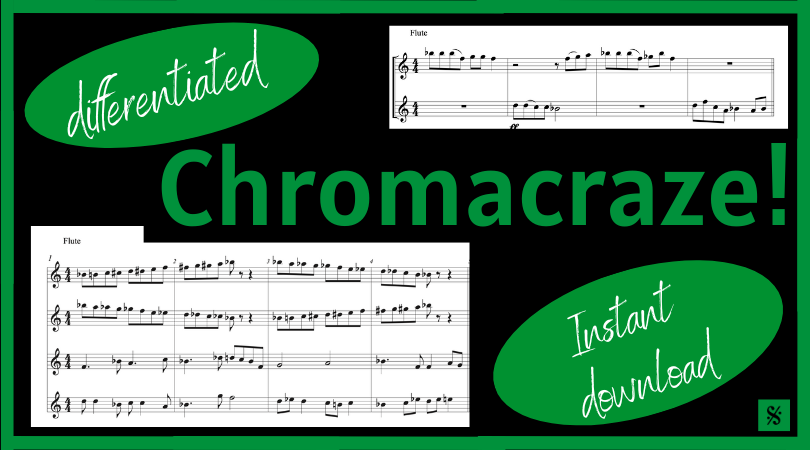
Chromacraze was the hit of Band Directors Workshop this year. We had many requests to make the entire packet available – so here you go!
Download the entire Chromacraze packet here.
Chromacraze Quartet (teach in 4 measure chunks)
1st part – chromatic scale in 1 octave (up, then down)
2nd part – chromatic scale in 1 octave (down, then up)
3rd part – in thirds and with a different rhythm
4th part – additional melody as a quartet
- Have all students play line 1. Then line 2. Then line 3. Then line 4.
- Then number them off to assign different parts to different students.
- Consider having students rotate through all parts in order. (Measures 1-4 – they play line1, directly to line 2, directly to line 3, directly to line 4. Group 2 starts on line 2, then 3,4,1)
- You can also use this to differentiate with students. Have some lower performing students in your group? Keep them on lines 1 & 2 while more advanced students play lines 3 & 4.
Obbligato
To differentiate further, add in the obbligato parts. These two parts can be played by two advanced students. Have 1 student play each part of the obbligato lines. Add this together with the original Chromacraze.
What I envision with the duet parts is playing it on a concert and having various pairs of students stand up and play 4 bars (most often beginning with one or more pickups from the previous bar). It would be particularly rewarding to see students at the bottom of their sections take in this challenge. This is all predicated on my strong belief that the chromatic scale is the wellspring of all technical development and that this little enterprise can make it more fun and less drudgery.
Here’s a recording of the 4 original chromacraze lines AND the obbligato lines.
Solo
Need even more of a challenge for some star students? Offer them the solo part! This solo part layers on top of the obligato or can be used instead of the obligato. It is very intricate, so another option is for a band director or lesson teacher to perform the solos with the band.
Here’s a recording of the 4 original chromacraze lines and the solo line.
Download the entire Chromacraze packet here.
Dr. Gary Garner, professor emeritus of music at West Texas A&M University, retired in 2002 after 39 years as WTAMU’s conductor of bands and orchestra. During his tenure, Garner managed to put the University’s music program on the map. He took the University’s Symphonic Band to Carnegie Hall two times and to perform at the Texas Music Educators Association annual convention a total of 10 times—more than any university band program in the state of Texas. In addition to his teaching and directing, Garner co-authored two books, recorded and arranged music and earned many honors from his peers and colleagues.
If you would like to have the amazing experience of performing in an ensemble under Dr. Garner’s direction, you can do so by attending Band Directors’ Workshop in Canyon, TX. Band Directors’ Workshop is an in-depth professional development opportunity in the summers that is FREE to attend. Dr. Garner conducts the Directors Band and all visiting directors are invited to participate. Click here for more information. This article is based on a small excerpt from a clinic Dr. Garner presented at Band Directors’ Workshop and is a sample of the excellent information provided at these clinics.








Leave a Reply
You must be logged in to post a comment.