Beginning band books for generations have implied that the horn is a difficult instrument to incorporate into an ensemble. They may not have explicitly made a statement to that effect but most of these resources have more pages for horn than the other instruments because there are “for horns only” pages. These pages put exercises into a better range for the beginning student but, if the student is primarily playing their instrument in an ensemble setting they are of little use. Regularly, these books extend the range of the horn part in ensemble playing to the highest notes of the beginning range if not higher. Often times students are not prepared for this challenge and end up having to strain to achieve the notes and can become very frustrated at their rate of progress on the instrument and in comparison to their peers.
What is it about the horn that brings about these unique challenges? Anyone that has been involved in music education for very long has heard that horn is a challenging instrument because the notes are so close together but what does this really mean? Is it really that different than other brass instruments?
Here is a look at the written notation of pitches available on a single F horn with no valves depressed:

In the beginning range there are 5 pitches, C, E, G, Bb, and C. The Bb is a very flat note and would not be played open on the horn but the important thing to note is that it is possible (especially when moving from written G to C!).
Compare the horn notes to the written notation of pitches on trumpet and trombone with no valves depressed:


Comparing all three instruments, we have the following information:

This information shows that horn players of any ability level will have more possible notes on the same fingering when compared to their peers in the brass section.
This is only part of the additional challenge facing the beginning horn player. As mentioned above, when a young student plays with their band, the notes are notated at the highest portion of the range. Why is this?
Most beginning band instruments are keyed in Bb, this is true of the trumpet, trombone, euphonium/baritone, tuba, tenor saxophone, and clarinet. The horn is an outlier being keyed in F with the written pitch a perfect 5th above the sounding pitch.
For example, take the following simple melody, performed in concert Bb major:
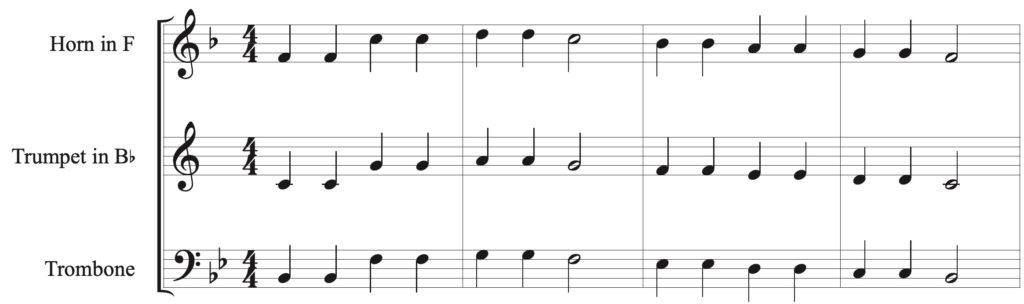
In this example, the horn is notated in the middle and top of the beginning range while the trumpet and trombone are notated at the bottom and middle of their range. For the trumpet and trombone, the first two printed pitches are on the same valve/slide position and only require adjustment to the air and embouchure to achieve the upper note. As a point of reference, in a successful first lesson on trumpet or trombone a student will likely learn to play these first two notes. Additionally, there is no note in between on that valve combination for those instruments to worry about. On the horn, there is a valve change when playing on a single F horn or a double horn and, whether they are on a single or double horn, there are additional possible notes between the F and the C that the student could play accidentally. Playing in this range takes time to develop and, if not properly coached, can create habits that will need to be fixed later on.
How do we get around this problem? Do we just accept that horn players will miss more notes and have a less enjoyable experience? I don’t think we do but there are some considerations we should make when helping young horn players. Because of the inherent challenges listed above, beginning horn players may need some extra love and care. Here are some ways to help those young hornists have a better chance at success:
- If you are involved in the instrument selection process, start students on the horn who already have a somewhat developed ear. Ear training, in general, is a great skill for all musicians and especially young hornists. Students with an already developed ability to accurately sing pitches will have a greater chance for success on the horn.
- Consider moving the horn part down an octave when approaching the higher beginning range. This allows the student to play in a comfortable range, minimizes the amount of bad habits they could develop by straining, and increases the likelihood of accuracy. This will result in having to re-write some parts, creating an occasional awkward large interval. If the student has a more developed ear this will be possible.
- When available, the double horn is always the best option for the student horn player. The double horn is the eventual instrument of any horn player and, since the transition to double horn comes so quickly after beginning, financially and pedagogically, the double horn is the most logical choice. It is always possible to only use the F side of the instrument in beginning instruction. Simply have the student perform without using the thumb valve and use only F horn fingerings. There is additional weight with a double horn but nothing so extreme that a young person cannot manage.
Understanding the challenges of the beginning horn player and guiding them to success is worth it. The sound of good horn playing is hard to beat! Yes, there are some accommodations that young horn players may need early on to find success and enjoyment on the instrument but these do not need to last forever. Take the time to help your young horn players succeed and reap the benefits!
Jonas Thoms is an Assistant Professor of Horn at West Virginia University. He has performed with the orchestras of Cincinnati, Columbus, Dayton, Ft. Wayne, Louisville, Nashville, Rochester, Syracuse, Toledo, and West Virginia, served on the faculty at the University of Cincinnati College-Conservatory of Music, Wright State University, University of Evansville, and the MasterWorks Festival, presented and performed at International Horn Symposia and regional workshops, and been published in The Horn Call, the International Horn Society’s Journal.
Related Reading:
10 Tips for Improving Accuracy on the Horn
Posture for the Developing Horn Player
Vive la Difference: the Uniqueness of the Horn
If you would like to receive our weekly newsletter, sign up here.
Don’t forget to like us on Facebook too!
Learn. Share. Inspire.
BandDirectorsTalkShop.com








Leave a Reply
You must be logged in to post a comment.