One of the challenges I have found in teaching band is giving students opportunities to actually make musical choices. In most of the repertoire we perform, many of those decisions have already been made. Dynamics, articulations, tempo, and style are printed on the page, and as the conductor, I make many of the remaining decisions for the ensemble.
There is nothing wrong with this process, but if the goal is to create more independent musicians, they also need opportunities to practice making musical choices on their own.
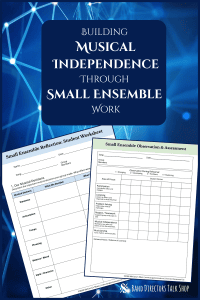
In my previous article, I explored how I introduce this process with the full ensemble, working together to make decisions about how the music should sound. Small ensemble work becomes the next step. Once students have had opportunities to practise that process together, I can step away and ask them to take greater responsibility for it themselves.
The Garner Ensemble Project, found here on the Band Director Talk Shop, has become one of the resources I use for this process, providing music that gives students room to make their own interpretive decisions.
For me, the goal is not simply to get students playing in small ensembles. It is to give them practice being responsible for the music they are performing.
Starting with Collaboration
Musical independence takes time.
When I first introduce small ensemble work, I start with at least two students on each part and establish clear expectations for the rehearsal process. This gives students an opportunity to learn how to rehearse together, make musical decisions, and listen to what is happening around them without me standing in front of the ensemble.
Having multiple students on each part also allows them to take turns performing and listening. While one student plays, another can listen and document whether the group’s musical choices are actually coming through in the performance.
As students become more comfortable with the process, I gradually move toward one student on each part. This increases the individual responsibility to enter confidently, maintain their own musical line, listen across the ensemble, and recover when something goes wrong.
Choosing the Right Music
The music I select for students depends on the goal we are currently working toward. Is the goal to focus on the technical aspects of the music, or on deciding how to perform it?
Both have value, but they create different rehearsal experiences. If the focus is expression, balance, articulation, phrasing, or communication, I do not want students spending the entire rehearsal trying to figure out notes and rhythms. More accessible music gives them room to listen, experiment, and make musical decisions. If the focus is technical independence, I can increase the difficulty and give students more time to rehearse.
The same is true when deciding whether every group performs the same piece or students select from several options. Providing choice can create more ownership and allow me to better match the music to the needs of each group. Having everyone perform the same piece creates a shared musical experience. Students become familiar with the material and can focus their listening on how each group interpreted it differently, creating a common starting point for discussion and reflection.
Making Musical Choices
Once students have their groups and their music, they are responsible for deciding how their piece will sound.
For this process, I look for music that provides students with the notes but leaves many of the expressive decisions open. Without predetermined dynamics, articulations, tempo, or phrasing, students have to decide what they want the music to sound like. I want them to experiment. What happens if this section is played staccato? Should the ending slow down? Which line should be most important?
Not every idea is going to work, and that is part of the process. Students need opportunities to try something, listen to the result, and decide whether they like it.
Each group receives an additional copy of the music that becomes their ensemble score. As they make decisions, they write them directly onto the score and their own parts. This requires students to commit to their decisions and gives them a plan to rehearse toward.
The student-created score also gives me something concrete to look at as I move between groups. Rather than immediately telling students how I think the music should sound, I can ask them about the choices they have already made.
At the end of the rehearsal process, each group performs for the class. Before they begin, I take their marked-up score and follow along as they perform.
This changes the way I listen. I am not necessarily listening to determine whether their interpretation matches the way I would conduct the piece. I am listening to hear whether they successfully communicated the musical ideas they decided on as a group.
If they marked a crescendo, did I hear it? If they decided that one line should become more important, did the balance change? If they chose a particular articulation, was it consistent?
Making the Process Assessable
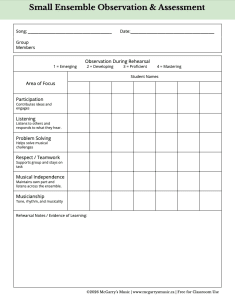
This whole process creates an excellent opportunity for assessment. As I move between groups during rehearsals, I can observe how students contribute ideas, listen to one another, solve problems, and respond to what they hear. These observations give me insight into the process that may not be visible in the final performance.
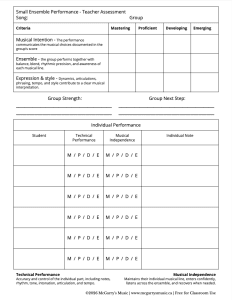
The score shows what the group intended, while the performance provides evidence of how successfully they communicated those decisions. I can still assess individual skills such as note and rhythm accuracy, tone, and musical independence, while also assessing the ensemble against the musical plan they created for themselves.
The question is not whether they made the same interpretive choices I would have made, but whether the choices they documented were communicated through their performance. If students are responsible for making musical decisions, the assessment needs to leave room for those decisions to be different from my own.
Instant download of my OBSERVATION AND ASSESSMENT SHEET here.
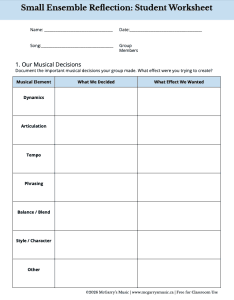
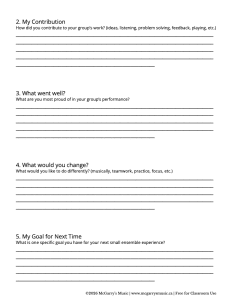
After the performance, students complete an individual reflection. They consider their contribution to the group, the musical decisions they made, and what they would change next time. When several groups perform the same piece, students can also compare interpretations and consider how different musical choices changed the performance.
Together, teacher observation, the score, the performance, and student reflection provide different evidence of learning: the process, the intention, the performance, and the student’s understanding. Reflection also allows students to identify a goal for their next small ensemble experience.
Instant download of my STUDENT REFLECTION SHEET here.
Stepping Away
Ultimately, building musical independence means allowing students to answer one simple question for themselves:
How do you want this music to sound?
Then giving them the time and responsibility to make it happen.
Dr. Dave McGarry is a music educator, composer, and conductor based in British Columbia, Canada. His work focuses on student-centred learning and creating musical experiences that help students become independent, thoughtful musicians. He holds a PhD in Music Education from Liberty University and shares compositions, educational resources, and teaching ideas through his website www.mcgarrysmusic.ca






Leave a Reply
You must be logged in to post a comment.